AFCI Arc-Fault Breaker Repair & Diagnostic Solutions in Sarasota
Eliminate frustrating nuisance trips and restore advanced electrical fire defense with specialized Arc-Fault Circuit Interrupter (AFCI) diagnostic services.
- AFCI (Arc-Fault Circuit Interrupter) breakers detect hazardous arcing before electrical fires ignite.
- Required by modern Florida Building Code for bedrooms, living rooms, and domestic habitable spaces.
- Nuisance tripping is commonly caused by shared neutrals, damaged appliance cords, or obsolete electronics.
- We use specialized arc-signature diagnostic analyzers to resolve AFCI tripping issues permanently.
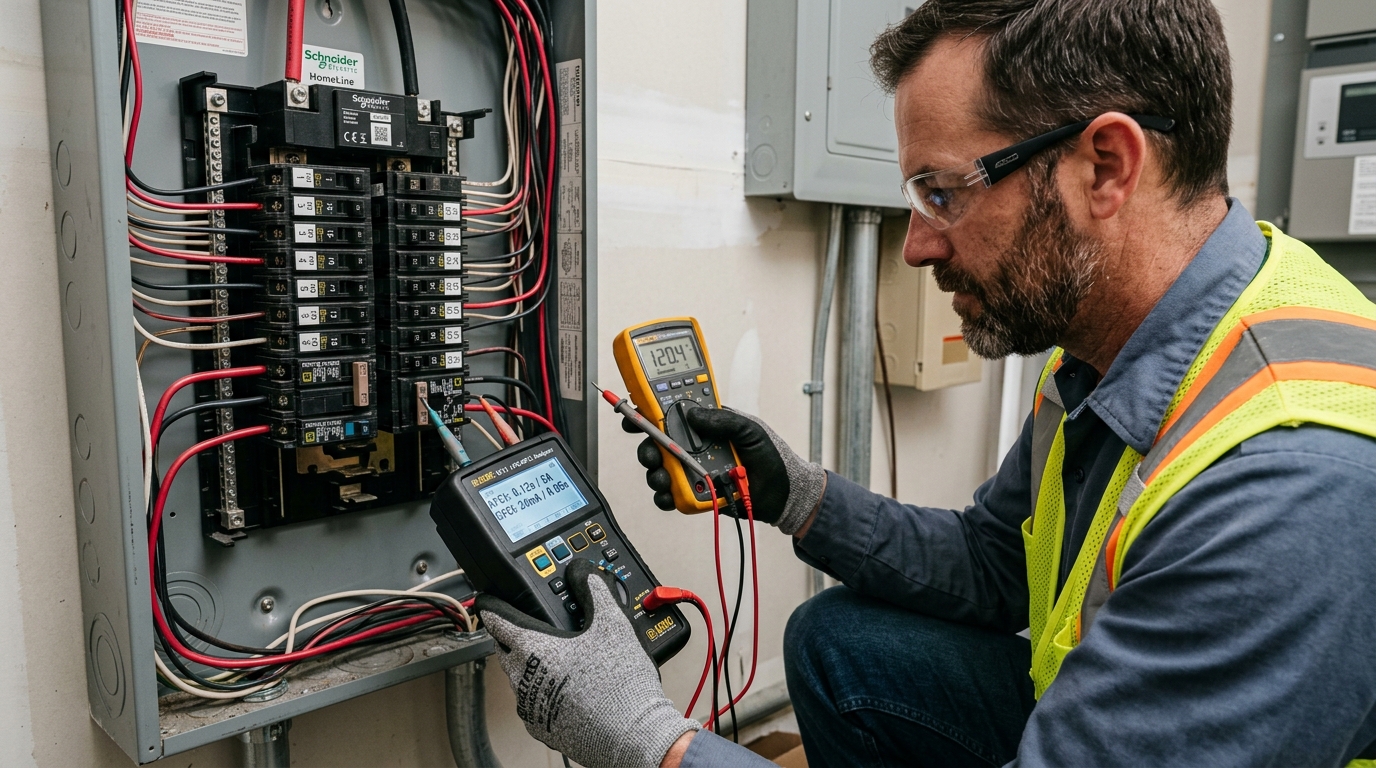
Professional Diagnostic & Repair Overview
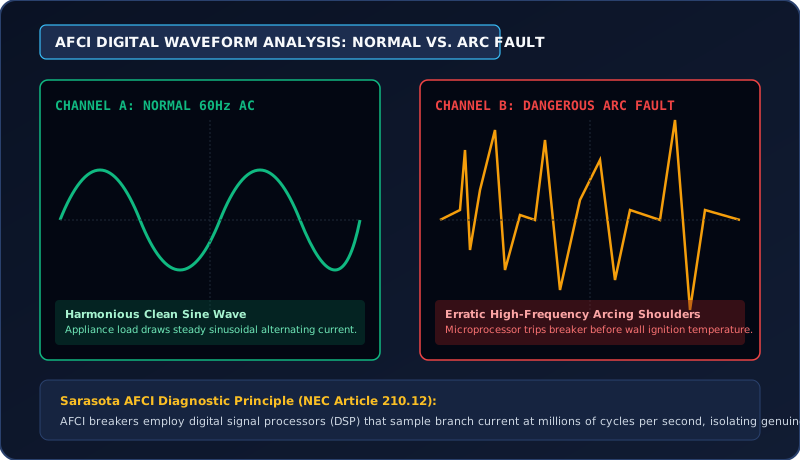
Arc-Fault Circuit Interrupters (AFCIs) represent one of the most significant electrical fire safety advancements of the past twenty-five years. While conventional circuit breakers only trip in response to massive overcurrent or direct dead shorts, AFCI breakers incorporate sophisticated microprocessors that continuously analyze electrical current waveforms. When an electrical arc occurs—such as when a nail pierces a wire behind drywall, a lamp cord is pinched under furniture, or a terminal connection loosens—it creates erratic high-frequency current signatures. AFCI breakers recognize these signatures and sever power before the 10,000°F arc can ignite wood framing or insulation.
However, AFCI breakers can be remarkably complex to troubleshoot. In Sarasota homes, homeowners frequently suffer from 'nuisance tripping,' where AFCI breakers trip seemingly at random without any obvious cause. Common triggers include shared neutral conductors (common in older multi-wire branch circuits), electrical noise from variable-speed motor drives, or degraded brush motors in older power tools and vacuums. Our specialized AFCI diagnostic services in Sarasota isolate legitimate arcing hazards from nuisance harmonic interference.
Series vs. Parallel Arc Faults: How AFCI Technology Protects Sarasota Homes
Understanding why an AFCI breaker trips requires distinguishing between series and parallel arcing. A parallel arc fault occurs when current jumps across damaged insulation between two separate conductors (such as hot-to-neutral or hot-to-ground). Because parallel arcing can draw substantial current, it may eventually trip a standard breaker, but an AFCI acts exponentially faster. A series arc fault, on the other hand, occurs along the length of a single broken or severed conductor. For example, if a copper wire inside a wall outlet junction box has snapped partially, current arcs across the tiny internal gap. Because the current is limited by whatever appliance is operating downstream, standard breakers will NEVER trip for a series arc fault—making AFCI protection vital for fire prevention.
Modern Florida Building Code mandates AFCI protection for virtually all 15- and 20-amp 120-volt branch circuits supplying outlets and lighting in bedrooms, living rooms, dining rooms, family rooms, and hallways. When retrofitting AFCI breakers into established Sarasota homes, our electricians frequently encounter legacy shared neutrals (multi-wire branch circuits utilizing a single neutral for two phases). Standard single-pole AFCI breakers will trip instantaneously if their neutral path is shared with another circuit. We solve these intricate legacy panel configurations using specialized two-pole AFCI breakers or re-routing individual neutral returns.
AFCI Breaker Troubleshooting Guide: Diagnostic LED Blink Codes
Refer to our diagnostic reference matrix below to evaluate common circuit failure signatures observed across Sarasota residential panels:
| Observed Symptom | Underlying Electrical Cause | Recommended Professional Action |
|---|---|---|
| 5 Blinks (Arc Fault Detected) | Unintentional electrical arcing across broken wire strand, loose terminal, or damaged cord | Inspect branch wiring with arc analyzer; replace damaged receptacles or appliance cords |
| 3 Blinks (Ground Fault Detected) | Current leaking to ground; neutral conductor touching bare ground wire inside wall box | Separate neutral and ground wires inside all downstream junction and switch boxes |
| 1 Blink (Thermal Overload) | Total connected appliance amperage exceeds 15A or 20A rating over sustained duration | Calculate connected branch loads; rebalance heavy devices to alternative circuits |
| No LED / Immediate Trip on Reset | Dead short circuit or internal microprocessor logic failure inside the breaker | Check for direct line-to-neutral short; replace failing AFCI breaker assembly |
Our Rigorous 5-Step Diagnostic & Service Methodology
We do not guess when dealing with lethal voltage. Every circuit breaker service in Sarasota County follows a calibrated, repeatable engineering protocol:
-
Diagnostic Code Retrieval
Modern AFCI breakers feature LED diagnostic trip codes (e.g., blinking patterns that indicate whether the last trip was an arc fault, ground fault, or overcurrent). We decode these diagnostics.
-
Branch Load Disconnection & Signature Scan
We disconnect downstream branch loads and evaluate circuit baseline insulation using high-voltage dielectric testers.
-
Outlet & Receptacle In-Wall Inspection
We examine device boxes along the circuit for back-stabbed push-in connectors, loose terminal screws, and nicked conductor sheathing.
-
Neutral Conductor Segregation
We verify that the circuit neutral is completely dedicated to that specific breaker and is not inadvertently cross-tied to another neutral in a multi-gang box.
-
Calibrated AFCI Replacement & Verification
If the breaker's internal electronics are degraded, we install a modern, advanced dual-function or AFCI unit with enhanced noise filtering.
If a circuit breaker immediately trips or sparks upon resetting, never force or hold the switch in the ON position. Circuit breakers feature a 'trip-free' internal mechanism, but forcing the lever against a dead short can cause severe arc-flash explosions, melt copper bus bars, or ignite wall framing. Leave the breaker OFF and call our certified team immediately.
Panel Brand Compatibility & Sizing Standards for Sarasota Homes
When repairing or replacing circuit breakers, matching exact bus stab geometries and interrupting capacity (AIC rating) is paramount. We install factory-certified replacements for:
- Square D (QO & Homeline): 10kAIC interrupting capacity, ensuring copper bus stabs seat firmly without contact micro-arcing.
- Siemens (QP & QT Series): Factory classified single-pole, double-pole, and tandem space-saver breakers.
- Eaton (Cutler-Hammer CH & BR Series): Genuine replacements for both commercial-grade 3/4-inch CH panels and residential BR load centers.
- General Electric (THQL & THQP): Matched thin-line and standard breakers for classic GE PowerMark distribution panels.
All terminal connections are torqued using calibrated torque screwdrivers in strict compliance with NEC 110.14(D) to prevent terminal loosening and overheating.
Florida Coastal Demands: Salt-Air Corrosion & Lightning Surge Factors
In Sarasota County, circuit breakers operate in an aggressive environment characterized by 90%+ relative humidity, airborne salt particles from Sarasota Bay, and severe summer thunderstorm activity. Moisture ingress and salt aerosols accelerate galvanic oxidation between copper branch wiring and aluminum bus stabs. In addition, lightning transients frequently degrade the delicate electronic sensing components within modern AFCI and GFCI breakers. Our diagnostic service includes testing whole-home surge protective devices (SPDs) to preserve breaker lifespan.
Frequently Asked Questions About AFCI Breaker Repair
Older vacuum cleaners use brushed universal motors that generate continuous mechanical arcing between carbon brushes and the commutator. If the AFCI breaker is an older generation or if the vacuum motor is worn, the breaker misinterprets this brush arcing as a dangerous wiring fault. Newer AFCI breakers have improved algorithmic filtering to prevent this.
AFCIs protect against electrical fires caused by arcing wires and loose connections throughout living areas. GFCIs protect humans against electric shock and electrocution by sensing when electrical current is leaking outside the circuit (such as through water or a person's body). Dual-function breakers combine both capabilities in a single unit.
Removing an AFCI breaker to install a standard thermal-magnetic breaker violates the National Electrical Code and Florida Building Code. More importantly, doing so can void your homeowner's insurance policy in the event of an electrical fire. The correct approach is identifying and resolving the underlying fault.
Serving Homeowners Across Sarasota County
Our diagnostic electricians frequently provide afci breaker repair services in nearby neighborhoods, including Siesta Key, Gulf Gate, Laurel Park, and Bee Ridge. Explore our localized neighborhood guides to see specific housing stock and panel failure factors in your area.