Professional Faulty Circuit Breaker Diagnosis & Testing in Sarasota
Advanced multimeter and thermal imaging diagnostics to determine if a circuit breaker is weak, scorched, internally worn, or failing under normal electrical load.
- Faulty breakers can fail in two dangerous ways: tripping prematurely, or failing to trip under catastrophic load.
- Non-invasive thermal imaging and calibrated resistance testing identify failing internal components.
- Physical inspection identifies micro-arcing, weakened spring tension, and burned plastic cases.
- We provide clear, honest diagnostic reporting so Sarasota homeowners know exactly why a breaker failed.
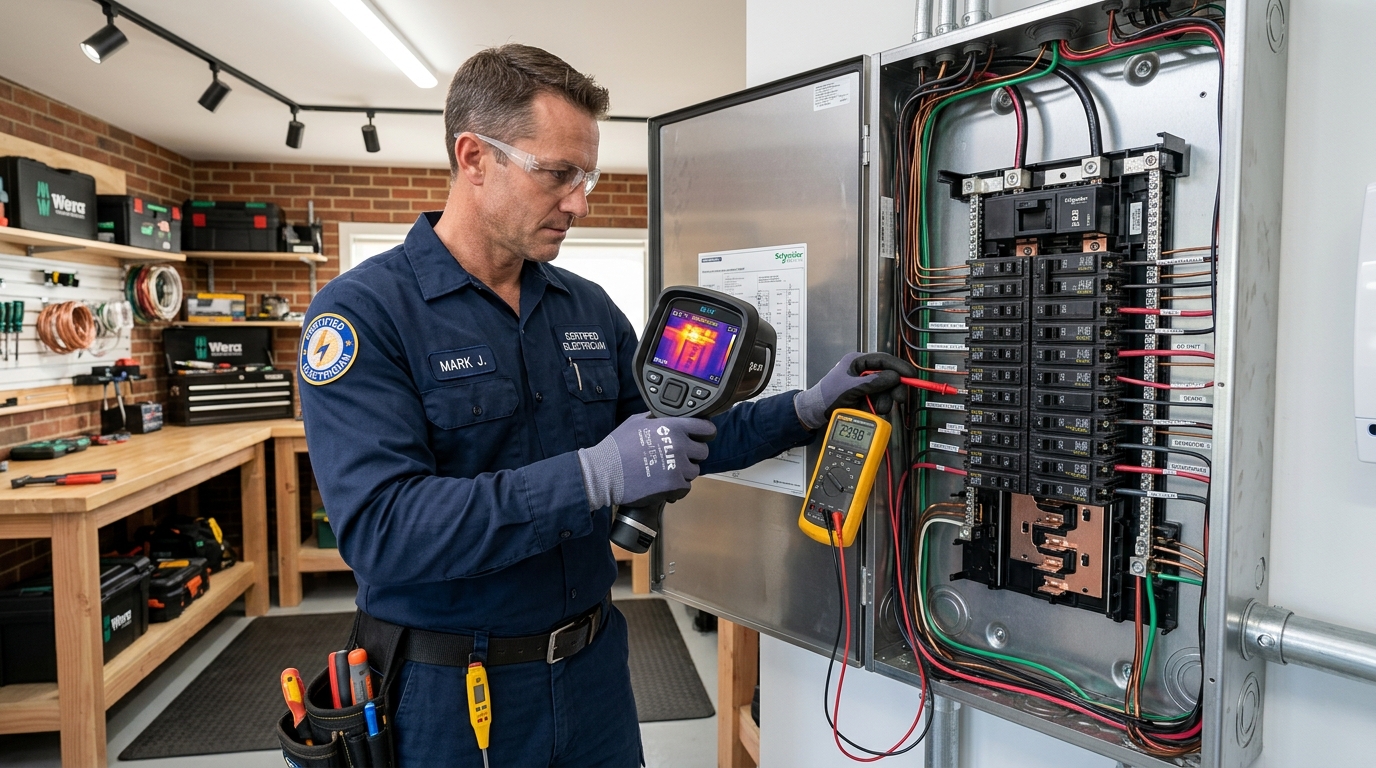
Professional Diagnostic & Repair Overview
Determining whether a circuit breaker is truly defective or merely responding to an external wiring fault is one of the most critical diagnostic challenges in residential electrical service. When a circuit loses power or trips repeatedly, many homeowners assume the breaker itself must be faulty and install a replacement, only to discover the new breaker trips in the exact same manner. Conversely, an even more terrifying scenario occurs when an internal mechanical failure causes a breaker to freeze closed—failing to trip even when conductors behind the wall reach scorching temperatures.
Our certified faulty breaker diagnosis in Sarasota utilizes advanced testing methodologies to assess the internal electromechanical health of your circuit breakers. We test thermal thresholds, mechanical latch release velocity, internal contact resistance, and bus stab clip tension. By definitively proving whether a breaker is operating within its manufacturer-certified UL trip curve, we save Sarasota homeowners unnecessary expenses while pinpointing concealed electrical dangers before they trigger catastrophic panel fires.
The Dangers of 'Stuck' Breakers & How Certified Testing Protects Your Home
Circuit breakers operate in an inactive state for 99.9% of their lifespan. Month after month, year after year, the internal mechanical springs remain fully tensioned under heavy pressure. In Sarasota's humid climate, microscopic corrosion, dust, and drying lubricants can cause the mechanical trip toggle to seize or become sluggish. When a severe short circuit or extreme overload occurs, a seized breaker will fail to trip. Thousands of amps of current will surge through branch wiring, melting the PVC insulation, filling the home with toxic smoke, and potentially igniting an electrical fire within wall cavities.
During a professional faulty breaker diagnosis, our technicians deploy calibrated test instruments. Non-contact FLIR thermal imaging cameras scan the entire breaker array while under operational load to detect localized hotspots exceeding 140°F. Digital micro-ohmmeters measure the resistance across the closed breaker contacts; a healthy breaker exhibits near-zero resistance, whereas an oxidized or arc-damaged breaker displays elevated milliohms that continuously generate destructive resistive heat. When combined with true-RMS ampacity measurements, this testing provides irrefutable proof of breaker condition.
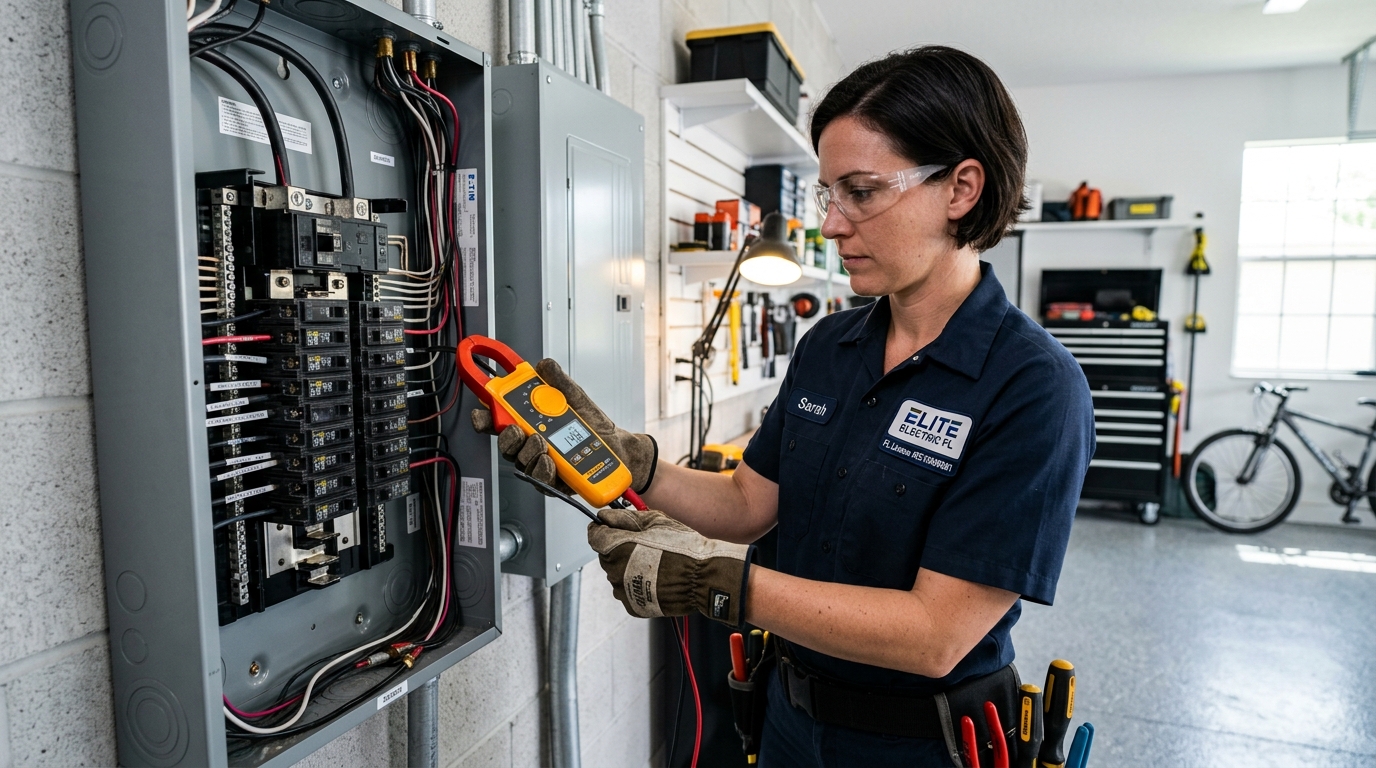
Diagnostic Testing Matrix: Faulty Breaker vs. External Circuit Fault
Refer to our diagnostic reference matrix below to evaluate common circuit failure signatures observed across Sarasota residential panels:
| Observed Symptom | Underlying Electrical Cause | Recommended Professional Action |
|---|---|---|
| Voltage Output is 0V with Switch in ON Position | Broken internal mechanical linkage, burnt open contact, or disconnected bus stab | Faulty Breaker: Requires immediate certified breaker replacement |
| Breaker Trips Instantly with Zero Devices Connected | Direct line-to-neutral or line-to-ground short circuit in branch building wiring | Downstream Fault: Breaker is functioning correctly; wiring must be traced and repaired |
| Breaker Shows >150°F on Thermal Scan at Low Amps | Severely pitted internal contacts or oxidized bus stab creating high contact resistance | Faulty Breaker / Bus: Replace breaker and recondition or relocate bus stab connection |
| Breaker Trips at Only 50% Rated Amperage | Calibrated bimetallic strip has drifted due to chronic thermal fatigue or internal spring failure | Faulty Breaker: Breaker mechanism has deteriorated; replace with new UL-listed unit |
Our Rigorous 5-Step Diagnostic & Service Methodology
We do not guess when dealing with lethal voltage. Every circuit breaker service in Sarasota County follows a calibrated, repeatable engineering protocol:
-
Infrared Thermographic Scan
We scan the breaker face, lugs, and surrounding bus connections with calibrated thermal imaging to identify dangerous thermal anomalies.
-
Live Circuit Load vs. Threshold Analysis
Using clamp meters, we measure real-time amperage on the circuit to verify whether the current is within the continuous 80% rating.
-
Terminal-to-Bus Voltage Drop Testing
We measure millivolt drop across the breaker under load; excessive voltage drop indicates burned or pitted internal contacts.
-
Physical Extraction & Mechanical Inspection
The breaker is removed from the energized bus to inspect spring action, case integrity, and bus stab clip retention tension.
-
Definitive Diagnostic Report & Solution
We explain whether the issue stems from an internal breaker defect, bus bar damage, or downstream wiring problems, offering targeted remediation.
If a circuit breaker immediately trips or sparks upon resetting, never force or hold the switch in the ON position. Circuit breakers feature a 'trip-free' internal mechanism, but forcing the lever against a dead short can cause severe arc-flash explosions, melt copper bus bars, or ignite wall framing. Leave the breaker OFF and call our certified team immediately.
Panel Brand Compatibility & Sizing Standards for Sarasota Homes
When repairing or replacing circuit breakers, matching exact bus stab geometries and interrupting capacity (AIC rating) is paramount. We install factory-certified replacements for:
- Square D (QO & Homeline): 10kAIC interrupting capacity, ensuring copper bus stabs seat firmly without contact micro-arcing.
- Siemens (QP & QT Series): Factory classified single-pole, double-pole, and tandem space-saver breakers.
- Eaton (Cutler-Hammer CH & BR Series): Genuine replacements for both commercial-grade 3/4-inch CH panels and residential BR load centers.
- General Electric (THQL & THQP): Matched thin-line and standard breakers for classic GE PowerMark distribution panels.
All terminal connections are torqued using calibrated torque screwdrivers in strict compliance with NEC 110.14(D) to prevent terminal loosening and overheating.
Florida Coastal Demands: Salt-Air Corrosion & Lightning Surge Factors
In Sarasota County, circuit breakers operate in an aggressive environment characterized by 90%+ relative humidity, airborne salt particles from Sarasota Bay, and severe summer thunderstorm activity. Moisture ingress and salt aerosols accelerate galvanic oxidation between copper branch wiring and aluminum bus stabs. In addition, lightning transients frequently degrade the delicate electronic sensing components within modern AFCI and GFCI breakers. Our diagnostic service includes testing whole-home surge protective devices (SPDs) to preserve breaker lifespan.
Frequently Asked Questions About Faulty Breaker Diagnosis
A tripped breaker will have its handle resting in the center position or the OFF position, and switching it firmly to OFF and back to ON will typically restore power (unless an active short exists). A truly bad breaker may have a loose, floppy handle with no spring resistance, emit a persistent burning smell, show visible soot or melted plastic, or fail to output voltage even when toggled ON.
Yes. Initial diagnostics such as infrared thermal scanning, load amperage measurement, and voltage drop testing across the input and output terminals are conducted while the breaker remains in place and operating under load. However, a conclusive evaluation of the rear bus stab requires extracting the breaker from the panel.
As breakers age and endure repeated thermal cycles, the laminated steel plates inside the magnetic trip assembly can loosen. When 60-cycle alternating current passes through, the loose steel plates vibrate mechanically against one another, creating an audible hum or buzz.
Serving Homeowners Across Sarasota County
Our diagnostic electricians frequently provide faulty breaker diagnosis services in nearby neighborhoods, including Siesta Key, Gulf Gate, Laurel Park, and Bee Ridge. Explore our localized neighborhood guides to see specific housing stock and panel failure factors in your area.