Certified Electrical Panel Safety Inspections in Sarasota, FL
Detailed 25-point breaker panel and electrical service safety inspections to protect your family, secure home insurance approvals, and identify hidden electrical hazards.
- Essential for Sarasota home sales, insurance 4-point inspections, and storm preparedness.
- Our certified 25-point inspection examines panels, grounding systems, bus bars, and breaker sizing.
- Identifies dangerous double-tapped breakers, undersized conductors, and hidden thermal hotspots.
- Includes non-invasive infrared thermal imaging analysis and full written documentation.
Professional Diagnostic & Repair Overview
In Florida's rigorous real estate and home insurance market, an electrical panel inspection is not merely a formality—it is a critical safeguard for your financial investment and family safety. Citizens Property Insurance and private Florida insurance carriers have instituted stringent 4-Point Inspection underwriting guidelines. Panels that exhibit signs of overheating, unpermitted modifications, improper breaker sizing, or obsolete equipment (such as fuse boxes, Zinsco, or Federal Pacific panels) can lead to immediate policy cancellation or denial of coverage across Sarasota County.
Our certified electrical panel safety inspections provide an exhaustive, top-to-bottom evaluation of your home's electrical service equipment. Led by seasoned master electricians with extensive knowledge of local Sarasota building codes and the National Electrical Code, our inspection verifies conductor sizing, grounding electrode systems, surge protection readiness, bus bar integrity, and breaker calibration. We deliver detailed, transparent documentation with high-resolution photographic evidence.
The 25-Point Comprehensive Electrical Panel Inspection Methodology
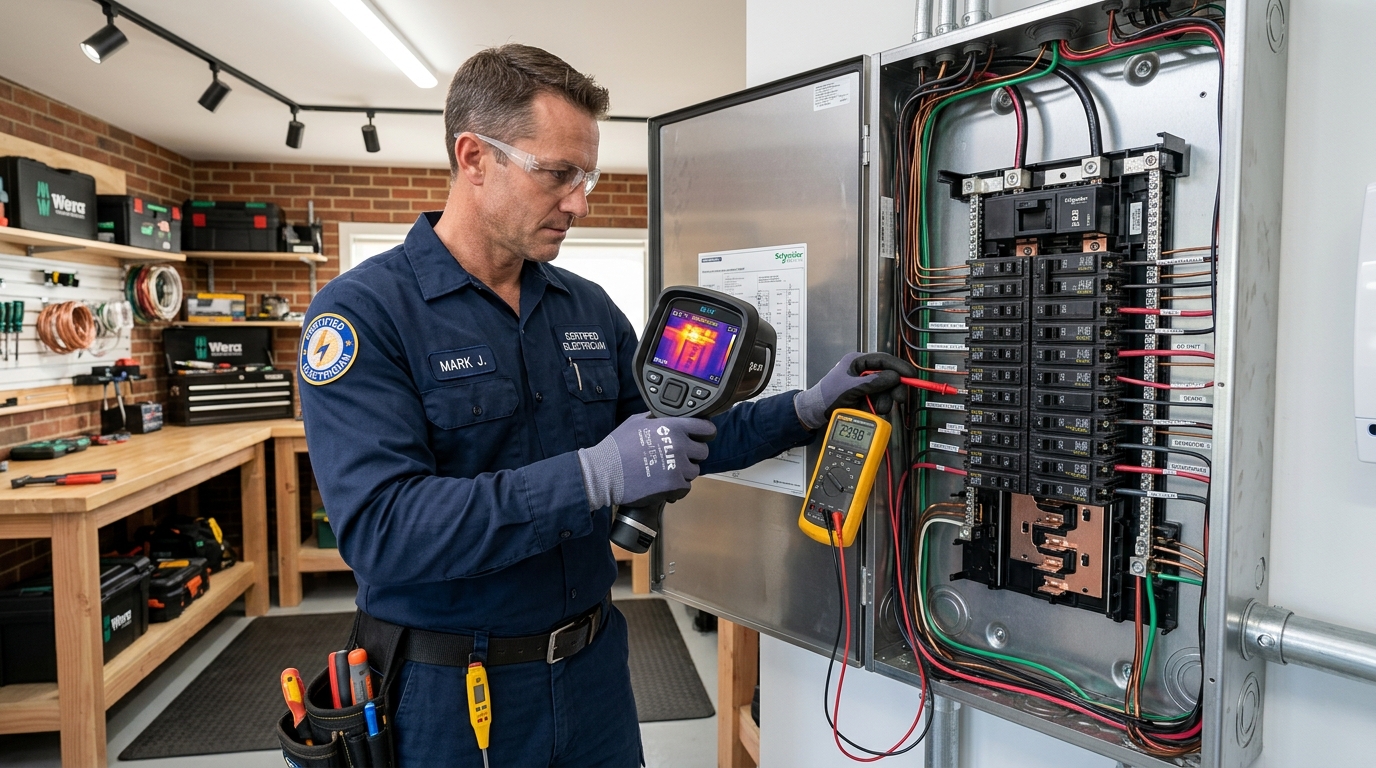
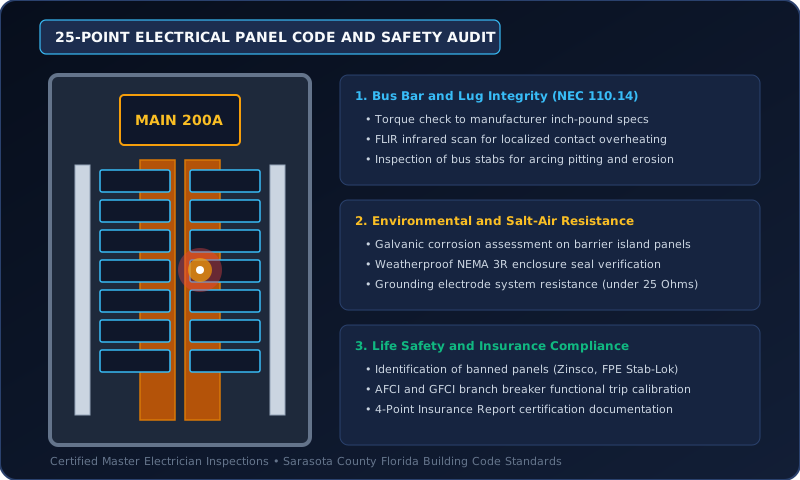
Our inspection protocol begins with non-invasive infrared thermography. Operating the panel under typical daily electrical load, we capture high-definition radiometric thermal images to identify concealed hotspots invisible to the naked eye. Loose terminal connections, overloaded circuits, and high-resistance bus stabs radiate distinct heat signatures that precede physical melting or electrical arcing. By catching these thermal signatures early, we prevent costly emergency outages.
Next, we perform a detailed mechanical and code compliance audit. We verify wire-to-breaker ampacity matching (ensuring 14 AWG copper is protected by 15A breakers, 12 AWG by 20A, and 10 AWG by 30A), examine neutral and grounding bus bars for illegal double-tapping (two conductors crammed into a single screw terminal designed for one), check main bonding jumper installation, and verify proper exterior grounding rod resistance and water meter bonding clamps. In coastal Sarasota, we pay exceptional attention to salt-air corrosion on panel enclosures and main service conduit seals.
Key Items Evaluated During a Sarasota Electrical Panel Inspection
Refer to our diagnostic reference matrix below to evaluate common circuit failure signatures observed across Sarasota residential panels:
| Observed Symptom | Underlying Electrical Cause | Recommended Professional Action |
|---|---|---|
| Conductor Ampacity Sizing | Ensures wire gauge matches circuit breaker rating to prevent wall conductor overheating | Prevents hidden in-wall electrical fires caused by oversized breakers |
| Double-Tapped Terminals | Checks whether multiple wires are improperly forced under a single breaker terminal screw | Eliminates high-resistance arcing connections and loose neutral paths |
| Grounding & Bonding Systems | Verifies grounding electrode rods, intersystem bonding, and main neutral bond | Protects against lightning surges and ensures rapid breaker trip during ground faults |
| Bus Bar Plating & Oxidation | Inspects copper/aluminum bus stabs for salt-induced corrosion, pitting, and scorching | Prevents catastrophic panel fires and costly whole-panel emergency replacements |
Our Rigorous 5-Step Diagnostic & Service Methodology
We do not guess when dealing with lethal voltage. Every circuit breaker service in Sarasota County follows a calibrated, repeatable engineering protocol:
-
Exterior Service Entrance & Conduit Inspection
We examine the utility meter base, service mast, weatherhead, and exterior conduit seals for moisture and salt intrusion.
-
Infrared Thermographic Heat Mapping
A comprehensive thermal scan detects loose lugs, overloaded breakers, and unbalanced phase conductors under live load.
-
Internal Component & Bus Bar Physical Audit
The dead-front panel cover is removed to inspect bus bar plating, breaker clamp retention, and signs of micro-arcing.
-
Grounding & Bonding System Verification
We test the grounding electrode conductor (ground rods), water pipe bonding, and main panel bonding strap integrity.
-
Comprehensive Written Inspection Report
You receive an itemized report documenting all findings, code compliance status, and clear recommendations for insurance or safety.
If a circuit breaker immediately trips or sparks upon resetting, never force or hold the switch in the ON position. Circuit breakers feature a 'trip-free' internal mechanism, but forcing the lever against a dead short can cause severe arc-flash explosions, melt copper bus bars, or ignite wall framing. Leave the breaker OFF and call our certified team immediately.
Panel Brand Compatibility & Sizing Standards for Sarasota Homes
When repairing or replacing circuit breakers, matching exact bus stab geometries and interrupting capacity (AIC rating) is paramount. We install factory-certified replacements for:
- Square D (QO & Homeline): 10kAIC interrupting capacity, ensuring copper bus stabs seat firmly without contact micro-arcing.
- Siemens (QP & QT Series): Factory classified single-pole, double-pole, and tandem space-saver breakers.
- Eaton (Cutler-Hammer CH & BR Series): Genuine replacements for both commercial-grade 3/4-inch CH panels and residential BR load centers.
- General Electric (THQL & THQP): Matched thin-line and standard breakers for classic GE PowerMark distribution panels.
All terminal connections are torqued using calibrated torque screwdrivers in strict compliance with NEC 110.14(D) to prevent terminal loosening and overheating.
Florida Coastal Demands: Salt-Air Corrosion & Lightning Surge Factors
In Sarasota County, circuit breakers operate in an aggressive environment characterized by 90%+ relative humidity, airborne salt particles from Sarasota Bay, and severe summer thunderstorm activity. Moisture ingress and salt aerosols accelerate galvanic oxidation between copper branch wiring and aluminum bus stabs. In addition, lightning transients frequently degrade the delicate electronic sensing components within modern AFCI and GFCI breakers. Our diagnostic service includes testing whole-home surge protective devices (SPDs) to preserve breaker lifespan.
Frequently Asked Questions About Electrical Panel Inspection
Insurance companies in Florida are exceptionally risk-averse due to hurricane exposure and litigation costs. Older electrical panels, unpermitted wiring modifications, and obsolete breaker boxes represent a major fire liability. Passing a 4-point electrical inspection is typically mandatory for homes over 20-30 years old in Sarasota.
A double-tap occurs when two separate branch circuit wires are connected into a single breaker terminal designed for only one conductor. Because the two wires cannot be torqued down evenly, one wire remains slightly loose, creating electrical arcing, overheating, and potential failure. This is one of the most common inspection flags in Sarasota.
Yes. Under current National Electrical Code (NEC Article 242) and Florida Building Code, all new and upgraded residential electrical services must include a Type 1 or Type 2 Whole-Home Surge Protective Device (SPD) to protect against Florida's notorious lightning surges.
Serving Homeowners Across Sarasota County
Our diagnostic electricians frequently provide electrical panel inspection services in nearby neighborhoods, including Siesta Key, Gulf Gate, Laurel Park, and Bee Ridge. Explore our localized neighborhood guides to see specific housing stock and panel failure factors in your area.