Precision Circuit Breaker Repair in Sarasota, FL
Rapid, certified diagnostic and repair solutions for buzzing, overheating, or malfunctioning circuit breakers across Sarasota County homes and businesses.
- Circuit breakers that buzz, fail to latch, or run hot require immediate professional diagnosis.
- In Florida's humid coastal climate, bus bar oxidation and loose terminal lugs accelerate breaker failure.
- Thermal-magnetic breakers feature internal bimetallic strips and magnetic solenoids that degrade over decades of cycling.
- Repair may involve terminal re-torquing, clip tension restoration, or targeted breaker replacement.
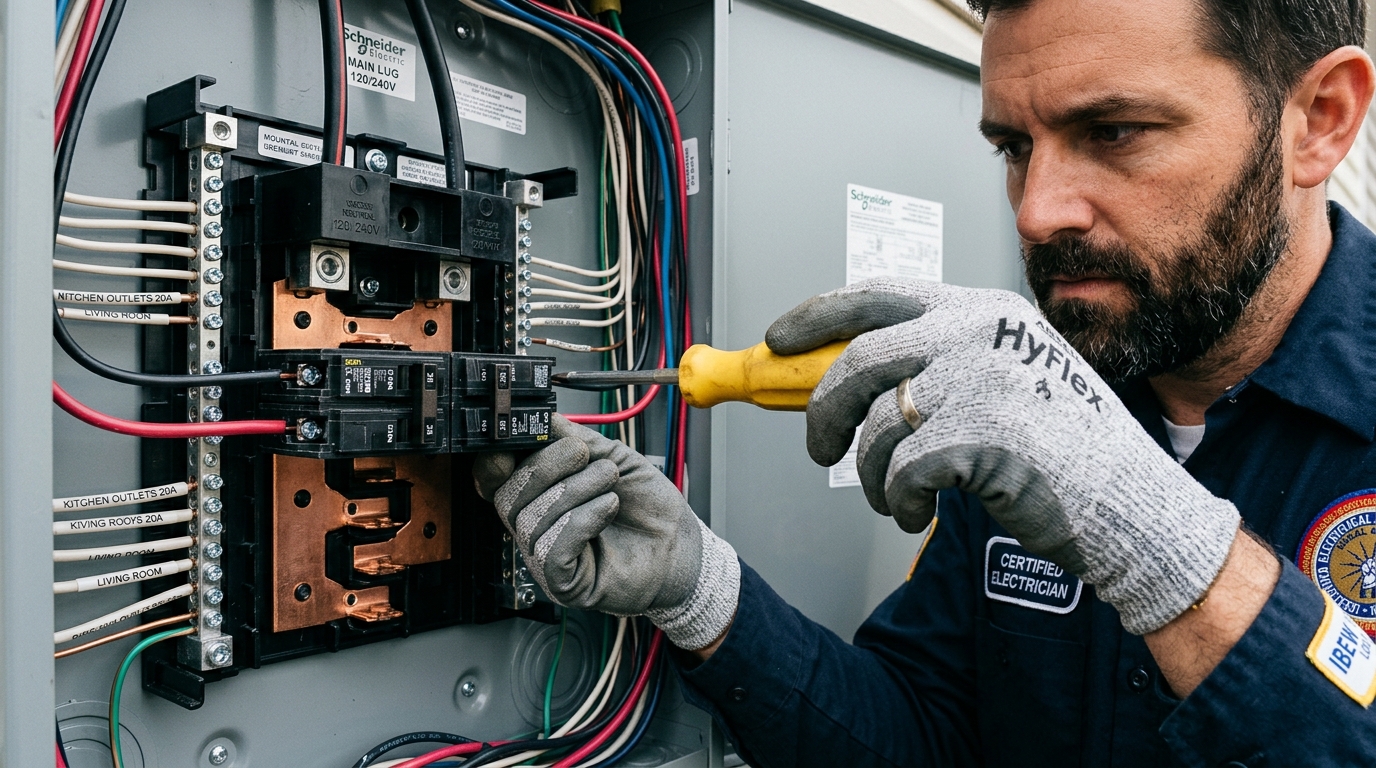
Professional Diagnostic & Repair Overview
When a circuit breaker in your Sarasota home malfunctions, your entire electrical distribution system is compromised. A circuit breaker is not merely an on-off toggle switch; it is a calibrated electromechanical safety mechanism engineered to interrupt current flow before wiring reaches temperatures that ignite surrounding wall studs, insulation, and building materials. In Sarasota, FL, where intense summer heat pushes residential air conditioning systems to operate continuously for 10 to 14 hours daily, circuit breakers endure sustained thermal strain that accelerates mechanical wear, contact pitting, and terminal degradation.
Our specialized circuit breaker repair services focus on identifying the precise physical mechanism that has failed within or around the breaker assembly. Unlike general handymen who simply swap breakers without investigating underlying system health, our diagnostic process examines panel bus bar integrity, terminal lug torque to manufacturer specifications (measured in inch-pounds), neutral bus phase balance, and branch circuit conductor health. Whether you are dealing with a breaker that emits an audible buzzing sound under moderate load, a switch lever that feels spongy and refuses to stay in the ON position, or a breaker casing that radiates noticeable heat, we provide rigorous, code-compliant remediation across Sarasota County.
The Physics of Circuit Breaker Operation & Common Failure Mechanisms in Florida
Modern residential circuit breakers employ a dual-action thermal-magnetic trip system. The thermal component utilizes a precision bimetallic strip composed of two distinct metals with different coefficients of thermal expansion bonded together. As continuous electric current passes through this strip, resistive heating causes the strip to bend gradually. If the current exceeds the breaker's rated capacity (such as a 20-amp breaker sustaining 26 amps), the deflection eventually releases the spring-loaded mechanical trip latch. In contrast, the magnetic component consists of an electromagnetic coil or solenoid that reacts instantaneously to high-magnitude overcurrent events—such as a direct short circuit. When extreme current surges through the coil, a powerful magnetic field pulls the armature, releasing the latch within milliseconds.
In coastal Sarasota, environmental factors significantly compound these physical mechanisms. High ambient relative humidity, airborne salt particles carried inland from Sarasota Bay and the Gulf of Mexico, and volatile afternoon thunderstorms create a punishing environment for breaker panels. Salt aerosols penetrate outdoor and garage-mounted electrical panels, creating microscopic galvanic corrosion layers where copper branch wires connect to steel terminal screws and aluminum bus tabs. This galvanic interface creates elevated electrical contact resistance. Over time, Ohm's Law (P = I²R) dictates that increased resistance generates severe localized heat, causing the breaker's internal thermal mechanism to drift out of calibration or melt the molded plastic casing entirely.
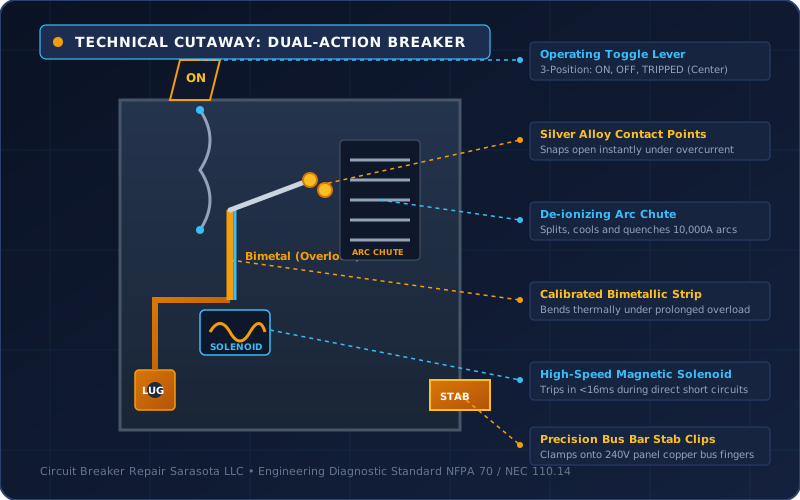
Circuit Breaker Diagnostic Matrix: Symptoms vs. Root Causes
Refer to our diagnostic reference matrix below to evaluate common circuit failure signatures observed across Sarasota residential panels:
| Observed Symptom | Underlying Electrical Cause | Recommended Professional Action |
|---|---|---|
| Audible Buzzing or Humming | Loose terminal screw, arc tracking, or alternating magnetic field vibration on an overloaded spring | Torque terminal to manufacturer spec or replace worn breaker assembly |
| Hot to the Touch (>140°F) | High contact resistance at bus stab, loose lug, or chronic over-amperage condition | Inspect bus bar for pitting; clean or replace breaker; balance circuit branch |
| Lever Won't Reset (Springs to Center) | Active short circuit, direct ground fault, or broken internal mechanical latch spring | Trace branch circuit wiring for dead shorts; test breaker isolation; replace if internally faulted |
| Acrid Burnt Plastic Odor | Severe arcing at bus connection, melted plastic housing, imminent electrical fire hazard | Immediate de-energization, panel bus evaluation, and code-certified component replacement |
Our Rigorous 5-Step Diagnostic & Service Methodology
We do not guess when dealing with lethal voltage. Every circuit breaker service in Sarasota County follows a calibrated, repeatable engineering protocol:
-
Thermal & Acoustic Evaluation
We inspect the breaker panel using non-contact infrared thermal scanners to detect abnormal heat signatures and acoustic sensors to isolate dangerous 60Hz arcing hums.
-
Load Ampacity Measurement
Using true-RMS clamp meters, our technicians measure actual real-time current draw across the affected circuit under full domestic operating loads.
-
Bus Bar & Stab Connection Inspection
The suspect breaker is carefully de-energized and extracted to inspect the rear metallic stabs for micro-arcing, black carbonization, and metal erosion on the panel bus fingers.
-
Mechanical Latch & Terminal Torquing
We verify mechanical spring tension, terminal screw integrity, and conductor stripping quality, torquing all connections according to NEC 110.14(D) standards.
-
Comprehensive Circuit Verification
After remediation, the circuit undergoes live functional testing and insulation resistance verification to ensure long-term stability and electrical safety.
If a circuit breaker immediately trips or sparks upon resetting, never force or hold the switch in the ON position. Circuit breakers feature a 'trip-free' internal mechanism, but forcing the lever against a dead short can cause severe arc-flash explosions, melt copper bus bars, or ignite wall framing. Leave the breaker OFF and call our certified team immediately.
Panel Brand Compatibility & Sizing Standards for Sarasota Homes
When repairing or replacing circuit breakers, matching exact bus stab geometries and interrupting capacity (AIC rating) is paramount. We install factory-certified replacements for:
- Square D (QO & Homeline): 10kAIC interrupting capacity, ensuring copper bus stabs seat firmly without contact micro-arcing.
- Siemens (QP & QT Series): Factory classified single-pole, double-pole, and tandem space-saver breakers.
- Eaton (Cutler-Hammer CH & BR Series): Genuine replacements for both commercial-grade 3/4-inch CH panels and residential BR load centers.
- General Electric (THQL & THQP): Matched thin-line and standard breakers for classic GE PowerMark distribution panels.
All terminal connections are torqued using calibrated torque screwdrivers in strict compliance with NEC 110.14(D) to prevent terminal loosening and overheating.
Florida Coastal Demands: Salt-Air Corrosion & Lightning Surge Factors
In Sarasota County, circuit breakers operate in an aggressive environment characterized by 90%+ relative humidity, airborne salt particles from Sarasota Bay, and severe summer thunderstorm activity. Moisture ingress and salt aerosols accelerate galvanic oxidation between copper branch wiring and aluminum bus stabs. In addition, lightning transients frequently degrade the delicate electronic sensing components within modern AFCI and GFCI breakers. Our diagnostic service includes testing whole-home surge protective devices (SPDs) to preserve breaker lifespan.
Frequently Asked Questions About Circuit Breaker Repair
While minor issues such as loose conductor terminal screws or oxidized wire tips can be serviced by re-stripping and torquing to NEC specifications, an internally damaged breaker with compromised bimetallic strips or carbonized bus stabs must always be replaced. Molded-case circuit breakers are sealed safety devices; opening the plastic housing destroys their UL listing and safety calibration.
Audible buzzing usually stems from one of two causes: loose wire connections creating microscopic electrical arcing, or excessive current flowing through the breaker that is just below the trip threshold, causing internal electromagnetic plates to vibrate at 60 Hz. Both conditions generate dangerous heat and should be examined immediately.
Under normal operating conditions, a circuit breaker handling a substantial load (such as a water heater or air conditioner) may feel slightly warm—typically between 90°F and 110°F. However, if the breaker feels uncomfortably hot to hold (above 130°F to 140°F) or displays any discoloration, it indicates excessive contact resistance or overload requiring professional service.
Serving Homeowners Across Sarasota County
Our diagnostic electricians frequently provide circuit breaker repair services in nearby neighborhoods, including Siesta Key, Gulf Gate, Laurel Park, and Bee Ridge. Explore our localized neighborhood guides to see specific housing stock and panel failure factors in your area.