GFCI Ground Fault Breaker Repair & Testing in Sarasota, FL
Protect your household from dangerous electrical shock in wet areas. We troubleshoot, test, and repair GFCI breakers for pool pumps, outdoor docks, kitchens, and baths.
- GFCI breakers protect against life-threatening electrical shock in wet and coastal environments.
- Crucial for Sarasota swimming pool pumps, outdoor boat docks, patios, kitchens, and bathrooms.
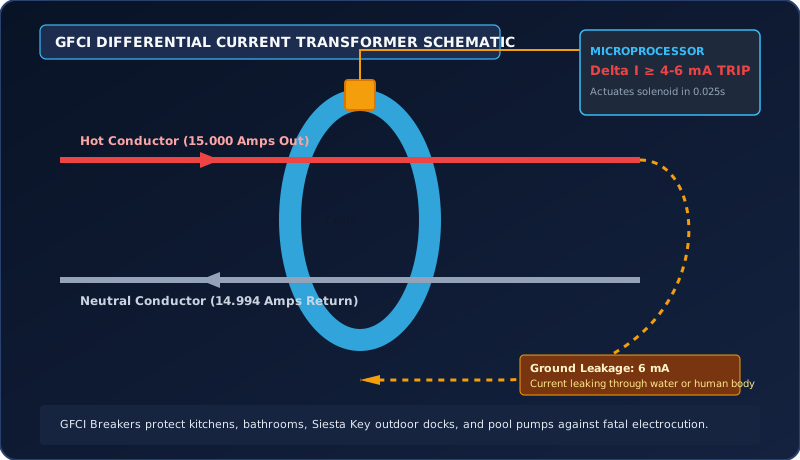
- Trips at microscopic current imbalances of 4 to 6 milliamperes in less than 25 milliseconds.
- We troubleshoot and repair moisture-compromised circuits and faulty GFCI breaker mechanisms.
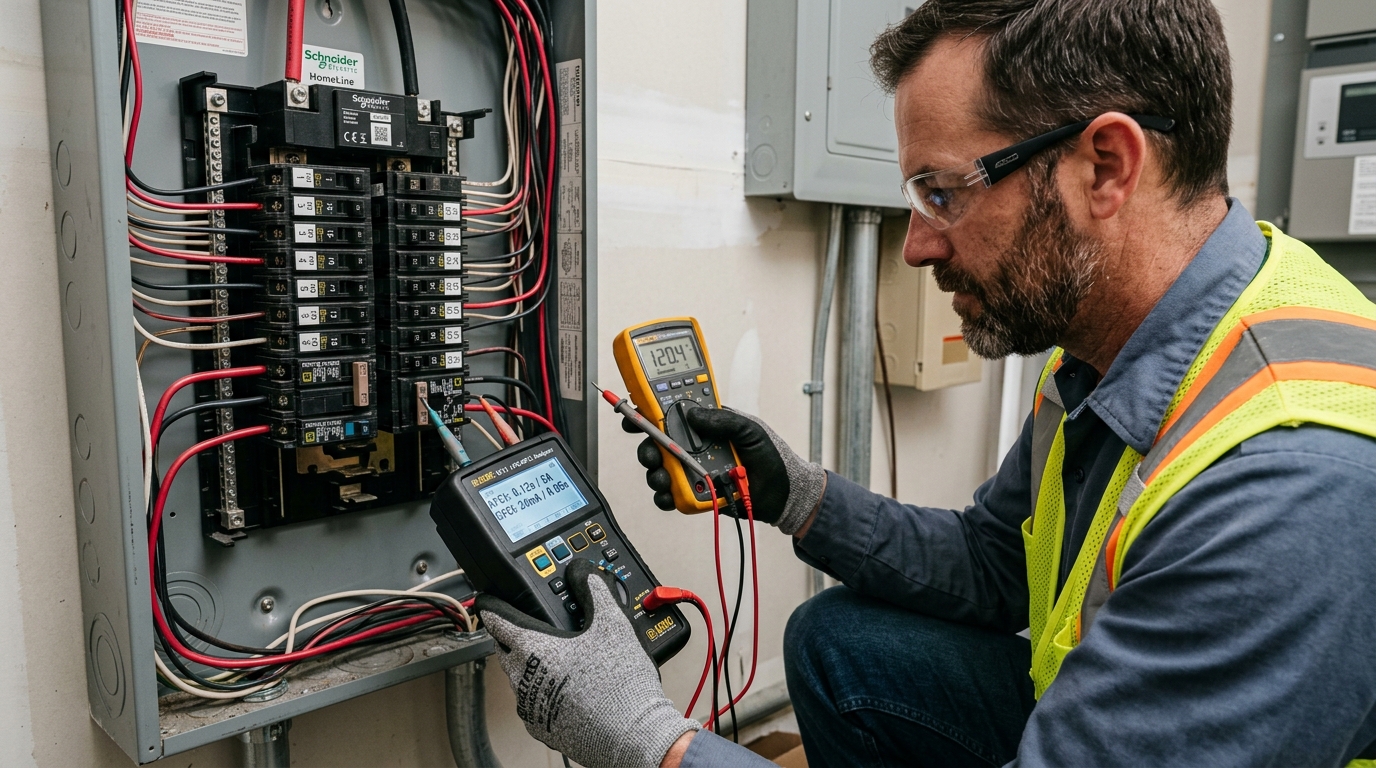
Professional Diagnostic & Repair Overview
Ground Fault Circuit Interrupter (GFCI) breakers provide critical life-safety defense against severe electric shock and electrocution. In Sarasota's subtropical environment—surrounded by the Gulf of Mexico, Sarasota Bay, inland canals, private swimming pools, and frequent coastal deluge storms—reliable ground fault protection is non-negotiable. While standard breakers protect structures against high-amperage overheating, a human heart can undergo fatal ventricular fibrillation at a mere 50 to 100 milliamperes of current. GFCI breakers are engineered to detect current leakage as miniscule as 4 to 6 milliamperes, cutting power in under 25 milliseconds.
A GFCI circuit breaker installed in your main electrical panel protects the entire length of the branch circuit, including all wiring, switches, and receptacles downstream. When a GFCI breaker in your Sarasota panel begins tripping intermittently, moisture ingress into exterior junction boxes, salt-encrusted outdoor outlets, pool pump motor winding degradation, or failing underwater landscape lighting are frequent culprits. Our diagnostic electrical team uses precision milliamp leak meters to locate the precise source of ground fault leakage without guesswork.
How GFCI Breakers Function & Why Sarasota's Marine Climate Causes Failures
The core engineering of a GFCI breaker relies on a differential current transformer (a toroidal sensing coil). In a healthy 120-volt circuit, the electrical current traveling out along the black 'hot' conductor must equal the exact current returning through the white 'neutral' conductor down to the milliamp. The toroidal coil continuously monitors these two opposing magnetic fields. As long as the currents are balanced, the magnetic fields cancel each other out. However, if current finds an alternative path to ground—such as through a cracked wire submerged in rainwater, a corroded pool pump housing, or a human touching an appliance with wet hands—a magnetic imbalance is created. This imbalance induces a voltage in the sensing coil, triggering the internal electronic relay to trip the breaker instantly.
Sarasota properties present severe environmental challenges for GFCI circuits. Coastal rainstorms, irrigation sprinkler overspray, and high humidity drive moisture into exterior outlet enclosures, pool timer boxes, and dock power pedestals. Over time, salt residue acts as an electrical conductor. Even tiny conductive moisture films between terminal screws and metal mounting boxes allow 5 or 6 milliamps of current to bleed to ground, tripping the panel GFCI breaker. Our comprehensive diagnostic process inspects every point of entry along the circuit to ensure weather-tight integrity.
GFCI Breaker Troubleshooting: Common Failure Modes in Sarasota
Refer to our diagnostic reference matrix below to evaluate common circuit failure signatures observed across Sarasota residential panels:
| Observed Symptom | Underlying Electrical Cause | Recommended Professional Action |
|---|---|---|
| Trips Only During Rainstorms or Sprinkler Cycles | Moisture ingress into unsealed exterior outlet boxes or cracked weather-proof bubble covers | Replace with NEC-compliant in-use extra-duty wet covers and watertight silicone gaskets |
| Trips Instantly When Pool Pump Motor Starts | Motor winding insulation breakdown, wet electrical whip, or failing motor start capacitor | Service pool pump motor connections; test motor winding ground isolation with megohmmeter |
| Won't Reset Even with All Devices Unplugged | Direct neutral-to-ground contact downstream, or defective internal GFCI sensing circuitry | Inspect wall boxes for bare ground wire touching neutral screws; replace faulty GFCI breaker |
| Fails Built-in 'TEST' Button Activation | Internal sensing solenoid failure, welded breaker contacts, or loss of internal reference ground | Immediate mandatory replacement; breaker no longer provides life-safety shock protection |
Our Rigorous 5-Step Diagnostic & Service Methodology
We do not guess when dealing with lethal voltage. Every circuit breaker service in Sarasota County follows a calibrated, repeatable engineering protocol:
-
Differential Leakage Current Analysis
Using high-resolution clamp-on leakage meters, we measure true milliamp leakage across the entire circuit to quantify ground loss.
-
Downstream Branch Segmentation
We systematically isolate outdoor receptacles, dock lighting circuits, pool timers, and interior wet-area loads to narrow down the leak source.
-
Moisture & Corrosion Infiltration Inspection
All exterior boxes, conduit seals, and waterproof covers are inspected for cracked gaskets, condensation, insect ingress, and salt corrosion.
-
Insulation Resistance Megohmmeter Testing
Conductors undergo 500V DC dielectric testing to identify degraded wire insulation inside underground PVC or wet conduits.
-
Component Remediation or Breaker Replacement
We reseal outdoor enclosures, replace corroded devices, or install a new factory-certified GFCI breaker if internal electronics have failed.
If a circuit breaker immediately trips or sparks upon resetting, never force or hold the switch in the ON position. Circuit breakers feature a 'trip-free' internal mechanism, but forcing the lever against a dead short can cause severe arc-flash explosions, melt copper bus bars, or ignite wall framing. Leave the breaker OFF and call our certified team immediately.
Panel Brand Compatibility & Sizing Standards for Sarasota Homes
When repairing or replacing circuit breakers, matching exact bus stab geometries and interrupting capacity (AIC rating) is paramount. We install factory-certified replacements for:
- Square D (QO & Homeline): 10kAIC interrupting capacity, ensuring copper bus stabs seat firmly without contact micro-arcing.
- Siemens (QP & QT Series): Factory classified single-pole, double-pole, and tandem space-saver breakers.
- Eaton (Cutler-Hammer CH & BR Series): Genuine replacements for both commercial-grade 3/4-inch CH panels and residential BR load centers.
- General Electric (THQL & THQP): Matched thin-line and standard breakers for classic GE PowerMark distribution panels.
All terminal connections are torqued using calibrated torque screwdrivers in strict compliance with NEC 110.14(D) to prevent terminal loosening and overheating.
Florida Coastal Demands: Salt-Air Corrosion & Lightning Surge Factors
In Sarasota County, circuit breakers operate in an aggressive environment characterized by 90%+ relative humidity, airborne salt particles from Sarasota Bay, and severe summer thunderstorm activity. Moisture ingress and salt aerosols accelerate galvanic oxidation between copper branch wiring and aluminum bus stabs. In addition, lightning transients frequently degrade the delicate electronic sensing components within modern AFCI and GFCI breakers. Our diagnostic service includes testing whole-home surge protective devices (SPDs) to preserve breaker lifespan.
Frequently Asked Questions About GFCI Breaker Repair
A GFCI breaker in the panel protects the entire circuit, including the home wiring concealed inside walls, ceilings, and exterior conduits. In contrast, a GFCI wall outlet only protects itself and devices connected downstream. For outdoor circuits, pool pumps, and difficult-to-access locations, panel-mounted GFCI breakers offer superior centralized protection.
The National Electrical Manufacturers Association (NEMA) recommends testing GFCI breakers once a month. Simply press the 'TEST' button on the face of the breaker; the switch should trip to the OFF or center position immediately. If pressing the test button does not trip the breaker, it is no longer providing shock protection and must be replaced.
Yes. GFCI breakers contain sensitive solid-state integrated circuits. Voltage transients from nearby Florida lightning strikes can easily fry the internal micro-transformer or sensing diode, rendering the breaker inoperable or causing continuous un-resettable trips.
Serving Homeowners Across Sarasota County
Our diagnostic electricians frequently provide gfci breaker repair services in nearby neighborhoods, including Siesta Key, Gulf Gate, Laurel Park, and Bee Ridge. Explore our localized neighborhood guides to see specific housing stock and panel failure factors in your area.