Emergency Short-Circuit Troubleshooting & Repair in Sarasota, FL
Immediate detection and repair of severe short circuits, melted wire insulation, and high-current electrical faults that cause instant breaker tripping and sparks.
- Short circuits produce dangerous sparks, explosive pops, and instant circuit breaker trips.
- Caused by pinched wires, rodent damage, failed appliance insulation, or water infiltration.
- Presents an immediate electrical fire and shock hazard that requires certified isolation.
- Our emergency technicians safely trace and isolate dead shorts throughout Sarasota County.
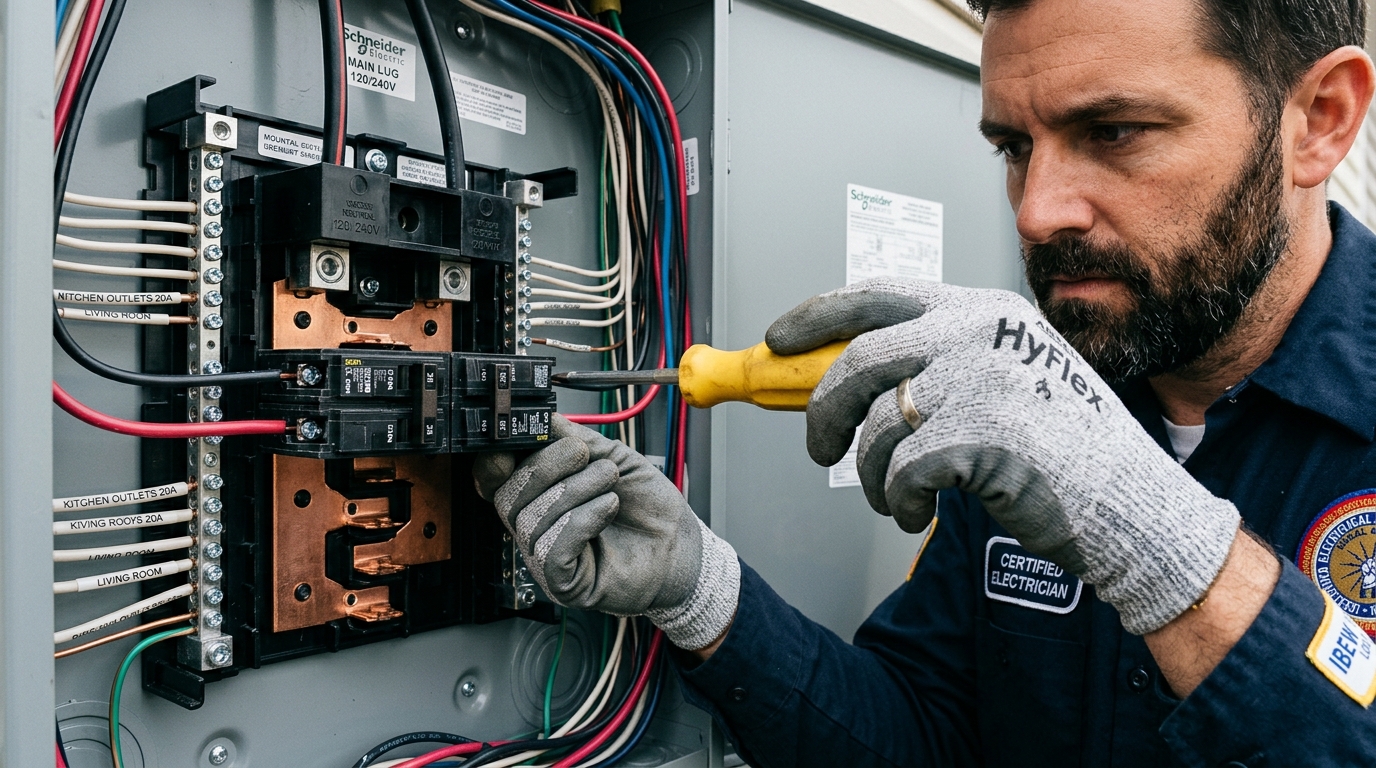
Professional Diagnostic & Repair Overview
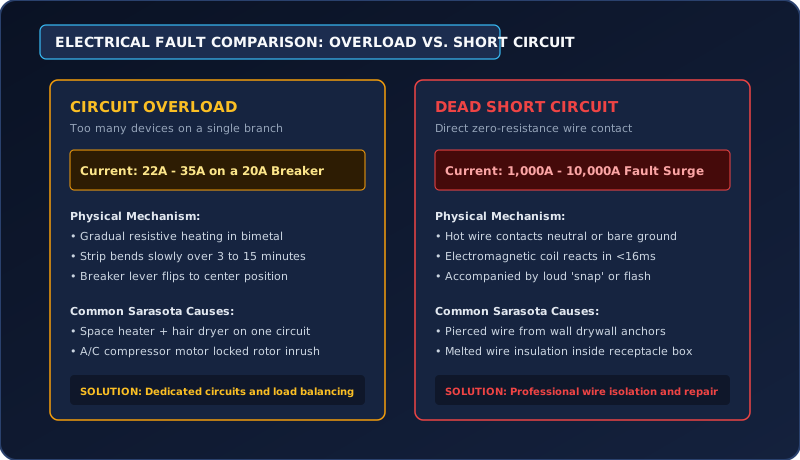
A short circuit is an acute electrical emergency. Unlike an overload that develops gradually as appliances run, a short circuit occurs with startling violence: a sudden loud snap or pop from your breaker box or wall outlet, a flash of blue light, an immediate loss of power, and often the pungent odor of scorched copper and melted plastic. When a short circuit happens, the electrical resistance of the circuit plummets to near zero, causing thousands of amperes of fault current to cascade through your Sarasota home's wiring in a fraction of a second.
Attempting to continually reset a circuit breaker that has tripped due to an active short circuit is extraordinarily hazardous. Doing so forces the breaker's contacts to close against an explosive fault, potentially creating an arc flash explosion, destroying the breaker, or igniting combustible materials inside your walls. Our Sarasota emergency electrical technicians utilize specialized insulation testers and fault-tracing tools to locate and isolate the short circuit safely.
Dead Shorts vs. Ground Faults: The Mechanics of Extreme Current Surges
In electrical engineering terms, a 'dead short' specifically refers to an unintended low-resistance connection between two energized conductors—typically the hot conductor (120V or 240V) and the grounded neutral conductor. Because current is governed by Ohm's Law (I = V/R), as resistance (R) approaches zero, current (I) approaches theoretical infinity, limited only by the impedance of the utility transformer and the resistance of the copper conductors. In a typical Sarasota residential service, an instantaneous fault current can exceed 5,000 to 10,000 amps. This massive surge creates intense electromagnetic forces and rapid explosive heating.
What causes short circuits in Sarasota residences? The most common culprits include physical wire damage during home renovations (such as drywall screws or picture-hanging nails puncturing concealed Romex cable), rodent activity chewing through insulation in attics and crawlspaces, internal component breakdown in motorized appliances, and moisture intrusion into outdoor or garage junction boxes. Our technicians systematically divide and conquer the circuit, isolating individual wiring sections until the precise fault location is exposed.
Short Circuit Diagnostic Indicators & Severity Levels
Refer to our diagnostic reference matrix below to evaluate common circuit failure signatures observed across Sarasota residential panels:
| Observed Symptom | Underlying Electrical Cause | Recommended Professional Action |
|---|---|---|
| Breaker Trips Instantly with Spark/Flash | Dead short circuit between hot and neutral conductors; immediate fire danger | Isolate shorted wire segment; replace damaged Romex cable and burnt receptacles |
| Breaker Trips Instantly with No Spark Visible | Concealed in-wall nail strike or internal mechanical failure within an appliance | Perform megohmmeter dielectric test; inspect wall cavities along the cable run |
| Scorched Outlet Face or Burnt Plastic Smell | High-temperature arcing short at device screw terminals due to loose back-stab connections | Replace compromised receptacle with commercial-grade side-wired device; trim scorched wire |
| Repeated Breaker Trips When Wall Switch Flipped | Direct short inside light fixture ballast, switch box pinch, or pinched wire at luminaire | Drop fixture, inspect canopy wiring, and replace defective switch or light assembly |
Our Rigorous 5-Step Diagnostic & Service Methodology
We do not guess when dealing with lethal voltage. Every circuit breaker service in Sarasota County follows a calibrated, repeatable engineering protocol:
-
Safety Verification & Emergency Lockout
We confirm the affected breaker is locked off and verify zero voltage across the circuit with calibrated test instruments.
-
Downstream Appliance Isolation
All connected electronics, appliances, and fixtures are unplugged or disconnected to determine if the fault is inside an appliance or building wiring.
-
Insulation Resistance Megohmmeter Testing
We inject 250V to 500V DC into the isolated circuit conductors to detect microscopic insulation breakdowns and hot-to-neutral shorts.
-
Sectional Junction Tracing
The circuit is opened at central junction points, testing each wiring run individually to isolate the specific wall cavity harboring the fault.
-
Conductor Replacement & Safe Re-Energization
Damaged wire sections are replaced or repaired according to code, devices are reconnected, and full load testing is performed.
If a circuit breaker immediately trips or sparks upon resetting, never force or hold the switch in the ON position. Circuit breakers feature a 'trip-free' internal mechanism, but forcing the lever against a dead short can cause severe arc-flash explosions, melt copper bus bars, or ignite wall framing. Leave the breaker OFF and call our certified team immediately.
Panel Brand Compatibility & Sizing Standards for Sarasota Homes
When repairing or replacing circuit breakers, matching exact bus stab geometries and interrupting capacity (AIC rating) is paramount. We install factory-certified replacements for:
- Square D (QO & Homeline): 10kAIC interrupting capacity, ensuring copper bus stabs seat firmly without contact micro-arcing.
- Siemens (QP & QT Series): Factory classified single-pole, double-pole, and tandem space-saver breakers.
- Eaton (Cutler-Hammer CH & BR Series): Genuine replacements for both commercial-grade 3/4-inch CH panels and residential BR load centers.
- General Electric (THQL & THQP): Matched thin-line and standard breakers for classic GE PowerMark distribution panels.
All terminal connections are torqued using calibrated torque screwdrivers in strict compliance with NEC 110.14(D) to prevent terminal loosening and overheating.
Florida Coastal Demands: Salt-Air Corrosion & Lightning Surge Factors
In Sarasota County, circuit breakers operate in an aggressive environment characterized by 90%+ relative humidity, airborne salt particles from Sarasota Bay, and severe summer thunderstorm activity. Moisture ingress and salt aerosols accelerate galvanic oxidation between copper branch wiring and aluminum bus stabs. In addition, lightning transients frequently degrade the delicate electronic sensing components within modern AFCI and GFCI breakers. Our diagnostic service includes testing whole-home surge protective devices (SPDs) to preserve breaker lifespan.
Frequently Asked Questions About Short-Circuit Troubleshooting
Do not attempt to reset the breaker. Unplug any appliances that were in use on that circuit. Check for smoke, burning odors, or warm wall plates. If you smell burning or see smoke, evacuate and call 911 immediately. Otherwise, keep the breaker in the OFF position and call an electrician.
Yes. Although a functioning circuit breaker trips in milliseconds, the initial spark and intense heat (reaching several thousand degrees) can ignite nearby drywall paper, dust, or cellulose attic insulation. This is why immediate professional inspection is essential following any dramatic short circuit event.
We use sophisticated diagnostic tools including tone generators, wire tracers, and high-precision insulation resistance testers. These instruments allow us to trace the path of the wire through drywall and pinpoint the exact distance to the fault, minimizing drywall cuts to just a few square inches.
Serving Homeowners Across Sarasota County
Our diagnostic electricians frequently provide short-circuit troubleshooting services in nearby neighborhoods, including Siesta Key, Gulf Gate, Laurel Park, and Bee Ridge. Explore our localized neighborhood guides to see specific housing stock and panel failure factors in your area.