Circuit Breaker Keeps Tripping? Troubleshooting & Repair in Sarasota
Tired of resetting the same breaker? We pinpoint whether circuit overload, short circuiting, or internal mechanism wear is causing your repeated breaker trips.
- Repeated breaker tripping indicates a protective safety system responding to an underlying fault.
- The three primary causes are circuit overloads, dead short circuits, and ground faults.
- Resetting a tripping breaker repeatedly can cause internal contact welding or structural electrical fires.
- Our Sarasota diagnostic service isolates the exact branch circuit component triggering the trip.
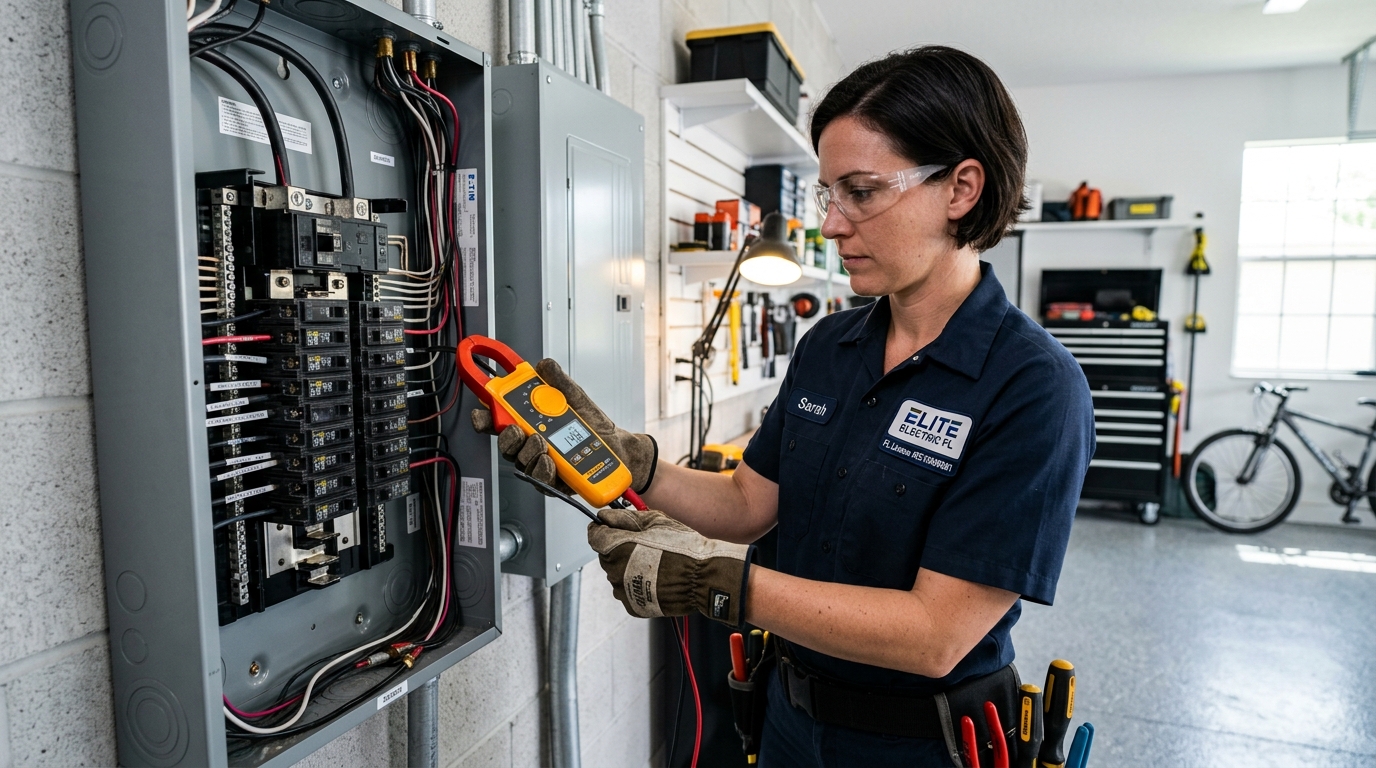
Professional Diagnostic & Repair Overview
Few household electrical frustrations compare to a circuit breaker that repeatedly trips every time you run a vacuum cleaner, turn on a microwave, or start your central air conditioning. However, it is vital to remember that a tripping breaker is not necessarily broken—it is actively doing its job to protect your Sarasota home from catastrophic wire overheating and electrical fires. When an electromechanical breaker trips, it is responding to an unsafe physical condition: either excessive current exceeding design ampacity, a short circuit with near-infinite fault current, or a sensitive ground fault.
Repeatedly forcing the breaker handle back to the ON position without investigating the underlying cause is dangerous. Every time a breaker trips under fault conditions, internal mechanical contacts separate against an intense electrical arc. If you continually force a breaker to reset against a live fault, you degrade the quenching contacts, risk welding them closed, or induce flash-over arcing inside your breaker box. Our diagnostic technicians perform methodical circuit isolation across Sarasota homes to trace whether the issue lies within the breaker itself, the wall conductors, or plugged-in appliances.
Tripping Root Causes: Differentiating Overloads from Sudden Short Circuits
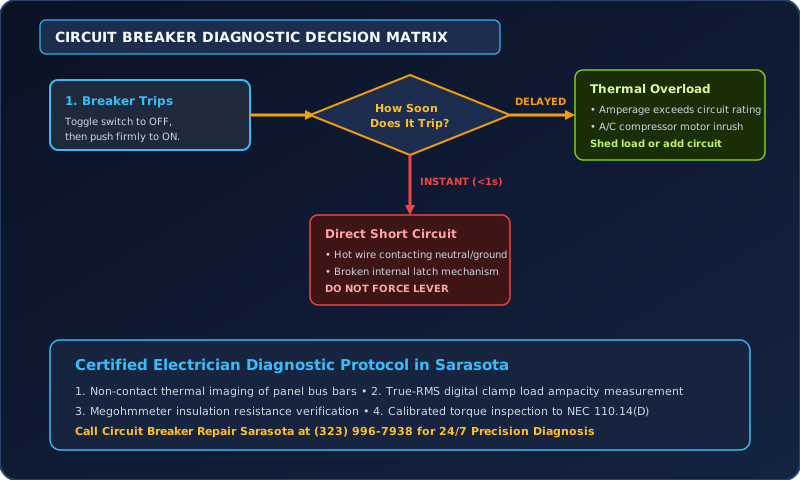
To resolve a tripping circuit breaker permanently, our electricians determine whether the trip event is thermal or magnetic. An electrical overload occurs when the total cumulative wattage of devices operating on a single branch circuit exceeds the maximum continuous threshold permitted by the National Electrical Code (NEC 80% continuous load rule). For example, a standard 15-amp, 120-volt circuit safely accommodates up to 1,440 continuous watts (or 1,800 maximum intermittent watts). Operating a 1,500-watt portable space heater or hair dryer concurrently with several lamps and a television forces 16 to 18 amps through the circuit. The bimetallic strip heats up gradually over 3 to 10 minutes before tripping.
In sharp contrast, a short circuit occurs when an energized 'hot' conductor makes direct physical contact with a grounded conductor (neutral wire) or the equipment grounding conductor (bare copper wire). This bypasses the electrical resistance of all appliances, causing current to spike instantaneously into hundreds or thousands of amps. When a short circuit happens, the electromagnetic trip coil inside the breaker reacts in less than one-sixtieth of a second, accompanied by a sharp click or muffled snap. If your breaker trips instantly upon resetting—even before any appliance switch is turned on—the issue is almost certainly a direct short circuit or grounded wire within your Sarasota residence.
Symptom Identification: Why Does Your Sarasota Breaker Trip?
Refer to our diagnostic reference matrix below to evaluate common circuit failure signatures observed across Sarasota residential panels:
| Observed Symptom | Underlying Electrical Cause | Recommended Professional Action |
|---|---|---|
| Trips After 5-15 Minutes of Appliance Use | Thermal Overload: Branch circuit is operating at 105% to 125% of rated capacity | Rebalance appliances to alternate circuits; install dedicated 20A branch circuit |
| Trips Instantly with an Audible 'Pop' or Flash | Direct Short Circuit: Hot conductor contacting neutral or bare ground wire | Isolate shorted wire segment, repair damaged insulation or replace faulty receptacle |
| Trips Only When Outdoor/Wet-Area Loads Run | Ground Fault: Moisture infiltration, motor insulation breakdown, or salt accumulation | Test GFCI current threshold; replace moisture-compromised outdoor weather covers |
| Trips Randomly with No Heavy Appliances On | Defective Breaker or Loose Neutral: Weak bimetallic strip or loose panel bus connection | Replace degraded circuit breaker; re-torque panel bus bar lugs to specification |
Our Rigorous 5-Step Diagnostic & Service Methodology
We do not guess when dealing with lethal voltage. Every circuit breaker service in Sarasota County follows a calibrated, repeatable engineering protocol:
-
Load Shedding & Visual Baseline
We unplug all connected branch appliances and inspect visible receptacles, switch plates, and junction boxes for scorch marks or loose devices.
-
Breaker Mechanical & Thermal Check
The breaker is toggled and evaluated for mechanical resistance, internal latch slip, and abnormal thermal signatures.
-
Branch Circuit Isolation & Resistance Testing
Using an insulation tester (megohmmeter) and digital multimeter, we test line-to-neutral and line-to-ground resistance across disconnected conductors.
-
Segmental Reconnection & Diagnostic Metering
We systematically reintroduce circuit branches while monitoring real-time amperage on an oscilloscope or digital clamp meter to isolate transient spikes.
-
Definitive Code-Compliant Correction
Once the root cause is isolated—whether an overloaded multi-outlet branch, damaged wire, or worn breaker—we implement permanent repairs.
If a circuit breaker immediately trips or sparks upon resetting, never force or hold the switch in the ON position. Circuit breakers feature a 'trip-free' internal mechanism, but forcing the lever against a dead short can cause severe arc-flash explosions, melt copper bus bars, or ignite wall framing. Leave the breaker OFF and call our certified team immediately.
Panel Brand Compatibility & Sizing Standards for Sarasota Homes
When repairing or replacing circuit breakers, matching exact bus stab geometries and interrupting capacity (AIC rating) is paramount. We install factory-certified replacements for:
- Square D (QO & Homeline): 10kAIC interrupting capacity, ensuring copper bus stabs seat firmly without contact micro-arcing.
- Siemens (QP & QT Series): Factory classified single-pole, double-pole, and tandem space-saver breakers.
- Eaton (Cutler-Hammer CH & BR Series): Genuine replacements for both commercial-grade 3/4-inch CH panels and residential BR load centers.
- General Electric (THQL & THQP): Matched thin-line and standard breakers for classic GE PowerMark distribution panels.
All terminal connections are torqued using calibrated torque screwdrivers in strict compliance with NEC 110.14(D) to prevent terminal loosening and overheating.
Florida Coastal Demands: Salt-Air Corrosion & Lightning Surge Factors
In Sarasota County, circuit breakers operate in an aggressive environment characterized by 90%+ relative humidity, airborne salt particles from Sarasota Bay, and severe summer thunderstorm activity. Moisture ingress and salt aerosols accelerate galvanic oxidation between copper branch wiring and aluminum bus stabs. In addition, lightning transients frequently degrade the delicate electronic sensing components within modern AFCI and GFCI breakers. Our diagnostic service includes testing whole-home surge protective devices (SPDs) to preserve breaker lifespan.
Frequently Asked Questions About Breaker Keeps Tripping
You may safely attempt to reset a tripped breaker once: first push the switch firmly to the full OFF position until you hear or feel a solid click, and then switch it smoothly to the ON position. If it immediately trips again or sparks, do not touch it further—leave it in the OFF position and call an electrician immediately.
Central AC units demand massive startup current (inrush current). If the condenser's dual-run capacitor has degraded, or if high ambient heat increases compressor head pressure, the compressor pulls excessive amperage that trips the double-pole breaker. Hard-start kits or breaker replacement may be necessary.
No. Standard surge-suppressing power strips protect sensitive electronics against high-voltage transient spikes (like lightning), but they do not increase branch circuit ampacity. Plugging multiple high-wattage items into a power strip often worsens circuit overloads.
Serving Homeowners Across Sarasota County
Our diagnostic electricians frequently provide breaker keeps tripping services in nearby neighborhoods, including Siesta Key, Gulf Gate, Laurel Park, and Bee Ridge. Explore our localized neighborhood guides to see specific housing stock and panel failure factors in your area.