Safe & Code-Compliant Circuit Breaker Replacement in Sarasota, FL
Upgrade worn, defective, or obsolete circuit breakers with precision-matched, manufacturer-certified replacements engineered for Florida's high electrical demands.
- Replacing worn or obsolete circuit breakers restores critical fire and short-circuit protection.
- Replacement breakers must match panel manufacturer specifications and bus stab geometry (UL listed combinations).
- Installing incorrect breaker brands in a panel voids insurance coverage and creates serious arc-fault fire risks.
- We provide exact-fit replacements for Square D, Siemens, Eaton, Cutler-Hammer, and GE panels.
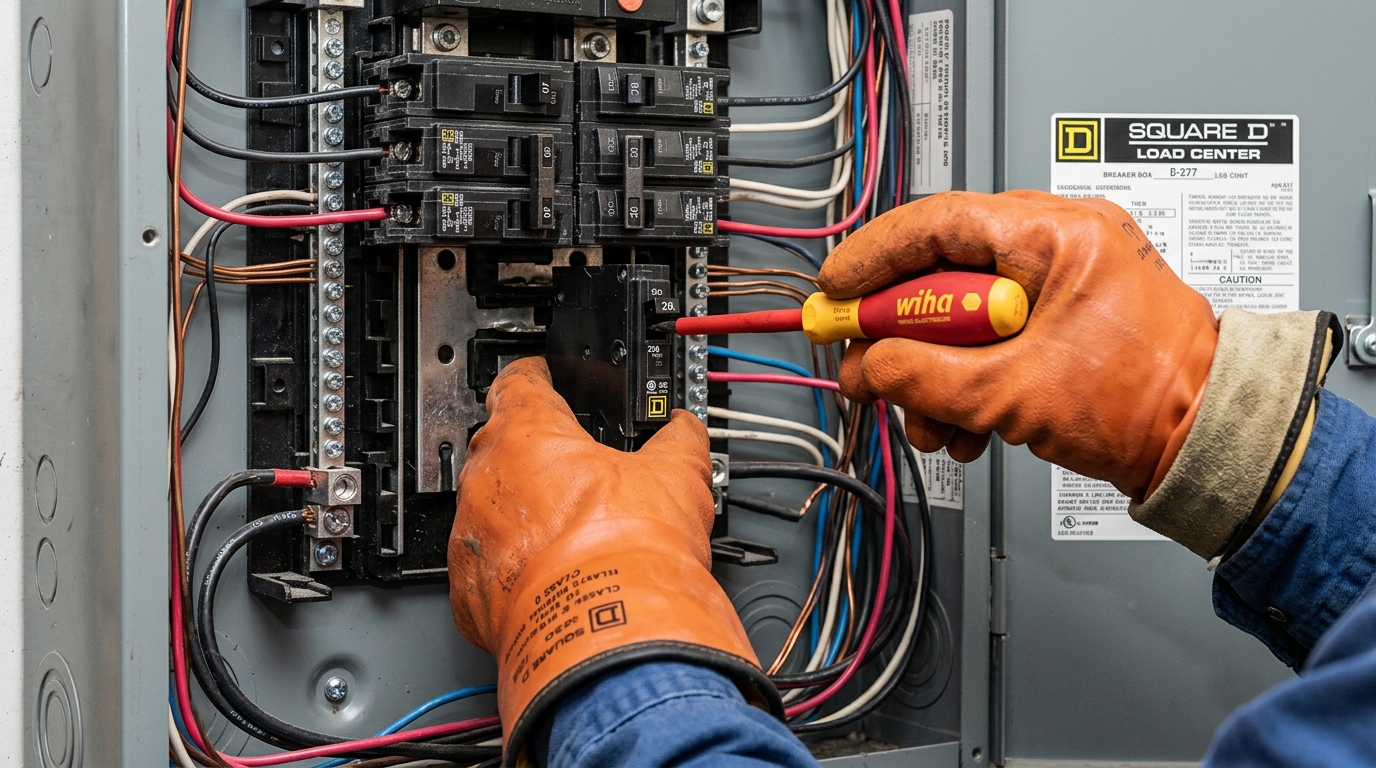
Professional Diagnostic & Repair Overview
When a circuit breaker reaches the end of its operational lifespan or experiences internal thermal breakdown, professional replacement is the only safe and code-compliant solution. Circuit breakers are mechanical devices with moving parts, tensioned springs, and sensitive calibrated alloys that inevitably degrade after thousands of thermal cycles and multiple trip events. In Sarasota homes, where tropical weather, air conditioner cycling, and seasonal power surges place exceptional demands on the electrical system, replacing obsolete or failing breakers is an essential preventive maintenance milestone.
Attempting to replace a circuit breaker without professional electrical training is exceptionally dangerous. The main bus bars inside an electrical panel remain energized with deadly 240-volt electrical current even when individual branch breakers are switched off. Furthermore, selecting the wrong replacement breaker—even if it mechanically slides into place—can create severe electrical hazards. Panels require specific breaker classifications (such as Classified or Type-Listed breakers) engineered to seat perfectly against the bus fingers without creating high-resistance gaps.
Matching Breakers to Panel Chemistry & The Danger of Brand Incompatibility
One of the most dangerous blunders encountered in Sarasota residential electrical panels is the 'universal fit' myth. Homeowners and unlicensed handymen frequently assume that any breaker purchased from a hardware store that snaps onto the rail is safe. In reality, each electrical panel manufacturer—such as Square D (QO vs. Homeline), Siemens, Eaton (CH vs. BR), Cutler-Hammer, and General Electric—engineers unique bus bar stab thicknesses, clamping clip tensions, and arc-chute exhaust vents. Forcing a mismatched breaker onto a bus bar creates microscopic air gaps. When high current flows through an imperfect contact point, electrical arcing occurs, eroding the silver plating of the bus bar and eventually destroying the panel interior.
During every breaker replacement in Sarasota, our certified electricians perform a meticulous inspection of the receiving bus bar finger. If the previous breaker experienced thermal failure, arcing may have pitted or melted the copper or aluminum bus bar. Installing a brand-new breaker onto a damaged bus tab will cause the new breaker to fail prematurely within weeks. If the bus stab is structurally compromised, we evaluate whether adjacent spare slots can be utilized or if panel bus bar reconditioning is required according to Florida Building Code and National Electrical Code standards.
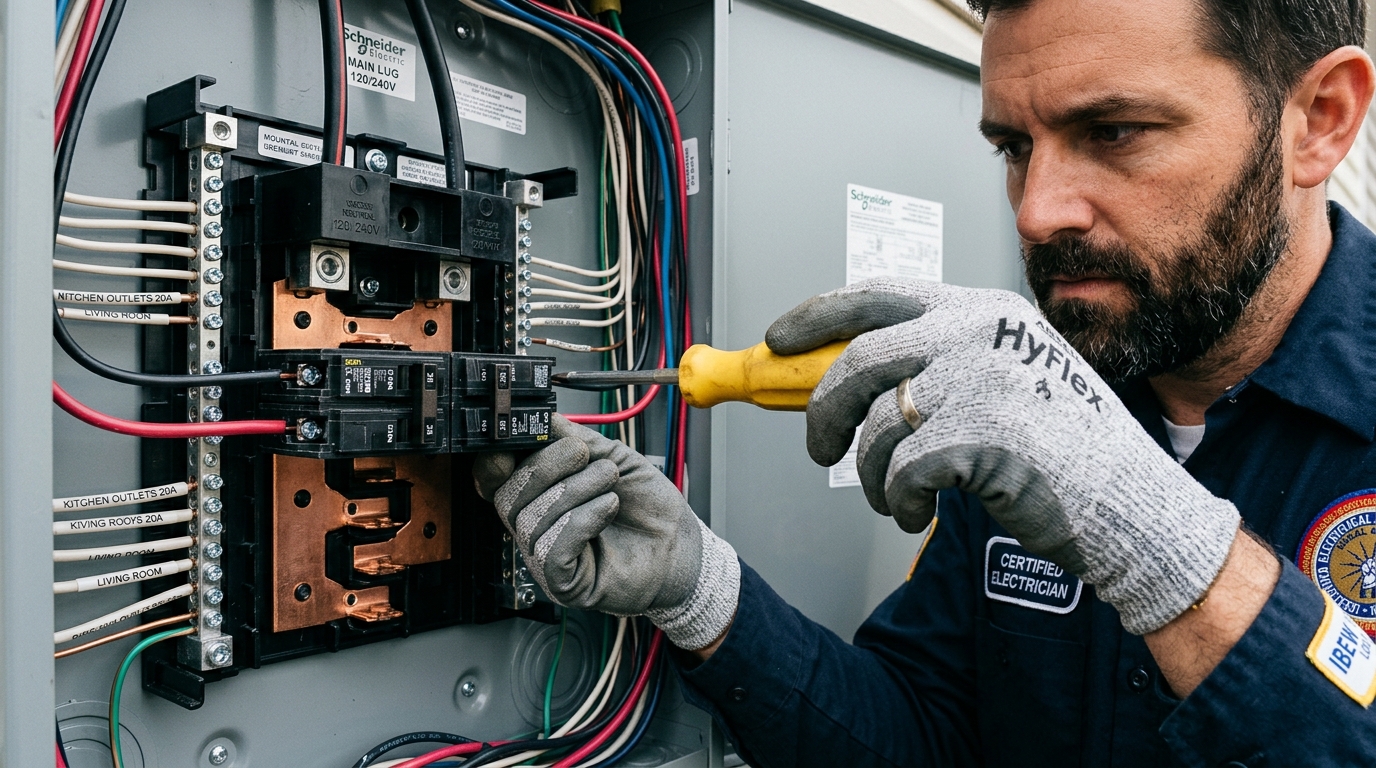
Common Breaker Types & Selection Criteria for Sarasota Residences
Refer to our diagnostic reference matrix below to evaluate common circuit failure signatures observed across Sarasota residential panels:
| Observed Symptom | Underlying Electrical Cause | Recommended Professional Action |
|---|---|---|
| Standard Single-Pole (15A - 20A) | 120V general lighting, bedroom outlets, small appliances | 14 AWG (15A) / 12 AWG (20A) copper wire; requires thermal-magnetic protection |
| Double-Pole Breakers (30A - 60A) | 240V heavy appliances: Central A/C compressors, electric water heaters, ranges | 10 AWG to 4 AWG copper; requires simultaneous two-phase trip mechanism |
| AFCI Arc-Fault Breakers (15A - 20A) | Living areas, bedrooms, hallways, family rooms (NEC modern code) | Microprocessor-based waveform analysis; detects hazardous electrical arcing |
| GFCI Ground-Fault Breakers (15A - 30A) | Bathrooms, kitchens, outdoor docks, pools, garages | Differential current sensing transformer; trips at 4-6 mA ground imbalance |
Our Rigorous 5-Step Diagnostic & Service Methodology
We do not guess when dealing with lethal voltage. Every circuit breaker service in Sarasota County follows a calibrated, repeatable engineering protocol:
-
Panel Isolation & Safety De-Energization
We secure the electrical workspace, utilize certified personal protective equipment (PPE), and test all conductors with calibrated voltage probes.
-
Manufacturer & Type Verification
We inspect the panel data placard to select the exact UL-listed breaker model, ampacity, and interrupting rating (AIC rating) required for your system.
-
Bus Bar Stab Condition Assessment
The degraded breaker is carefully extracted to inspect the metallic panel bus bar for pitting, copper oxidation, and mechanical integrity.
-
Precision Conductor Installation & Torquing
Conductors are inspected for heat damage, trimmed and stripped cleanly, and secured into terminal lugs using calibrated torque screwdrivers.
-
Full Operational Load & Trip Testing
We re-energize the panel, apply normal household electrical load, and verify operating temperature, voltage drop, and mechanical latching.
If a circuit breaker immediately trips or sparks upon resetting, never force or hold the switch in the ON position. Circuit breakers feature a 'trip-free' internal mechanism, but forcing the lever against a dead short can cause severe arc-flash explosions, melt copper bus bars, or ignite wall framing. Leave the breaker OFF and call our certified team immediately.
Panel Brand Compatibility & Sizing Standards for Sarasota Homes
When repairing or replacing circuit breakers, matching exact bus stab geometries and interrupting capacity (AIC rating) is paramount. We install factory-certified replacements for:
- Square D (QO & Homeline): 10kAIC interrupting capacity, ensuring copper bus stabs seat firmly without contact micro-arcing.
- Siemens (QP & QT Series): Factory classified single-pole, double-pole, and tandem space-saver breakers.
- Eaton (Cutler-Hammer CH & BR Series): Genuine replacements for both commercial-grade 3/4-inch CH panels and residential BR load centers.
- General Electric (THQL & THQP): Matched thin-line and standard breakers for classic GE PowerMark distribution panels.
All terminal connections are torqued using calibrated torque screwdrivers in strict compliance with NEC 110.14(D) to prevent terminal loosening and overheating.
Florida Coastal Demands: Salt-Air Corrosion & Lightning Surge Factors
In Sarasota County, circuit breakers operate in an aggressive environment characterized by 90%+ relative humidity, airborne salt particles from Sarasota Bay, and severe summer thunderstorm activity. Moisture ingress and salt aerosols accelerate galvanic oxidation between copper branch wiring and aluminum bus stabs. In addition, lightning transients frequently degrade the delicate electronic sensing components within modern AFCI and GFCI breakers. Our diagnostic service includes testing whole-home surge protective devices (SPDs) to preserve breaker lifespan.
Frequently Asked Questions About Circuit Breaker Replacement
Under standard conditions, circuit breakers are engineered for a service life of 25 to 35 years. However, in Sarasota's coastal climate with high humidity, salt air exposure, and frequent lightning-induced voltage surges, breakers often require replacement after 15 to 20 years, particularly those powering heavy inductive loads like air conditioning compressors.
Absolutely not. This is one of the most hazardous electrical code violations possible. Circuit breakers are strictly sized to protect the gauge of copper wire concealed behind your walls (14-gauge wire is rated for a maximum of 15 amps). Installing a 20-amp breaker on 14-gauge wire allows the wiring to overheat and ignite wall insulation long before the breaker ever trips.
AIC stands for 'Ampere Interrupting Capacity.' It indicates the maximum fault current the breaker can safely interrupt without exploding or welding its internal contacts shut. Most residential Sarasota panels require a minimum 10,000 AIC (10kAIC) rating to withstand severe short circuits safely.
Serving Homeowners Across Sarasota County
Our diagnostic electricians frequently provide circuit breaker replacement services in nearby neighborhoods, including Siesta Key, Gulf Gate, Laurel Park, and Bee Ridge. Explore our localized neighborhood guides to see specific housing stock and panel failure factors in your area.